
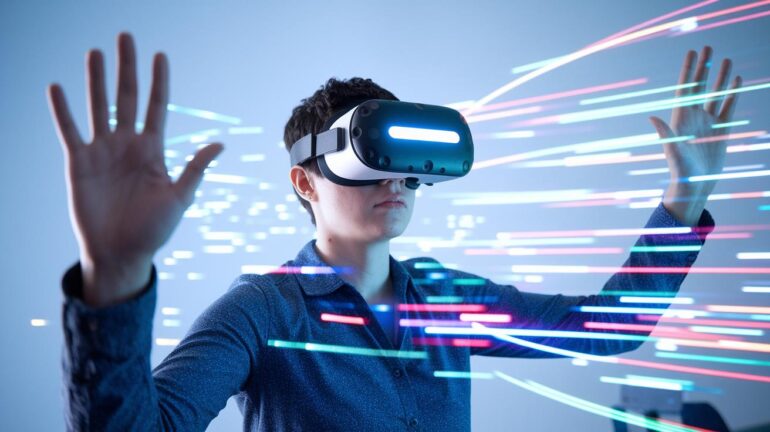
Ever thought your VR gear could get even smarter? Picture a headset that follows your every move with super accuracy, thanks to cool radar tech (that means it tracks you like a pro). This review shows how nimble sensors mix live space data with awesome visuals, making your gameplay feel way more alive. We break down the specs, speed, and design to prove that this bold performance isn’t just hype, it’s where VR gaming is headed. Ready to see your play transform into something epic?
Comprehensive Virtual Reality Interface Review Radar Overview
Virtual reality is like stepping into a digital world with a headset that makes you feel like you’re really inside the action. It pulls you away from the everyday and drops you right into another realm, while augmented reality adds extra digital details over your real-world view. Most of today’s VR games are solo adventures or neat 360° video experiences. But imagine using radar tech to give real-time location info, it could make your VR moments smoother and way more interactive.
Picture this: you’re playing, and the system tracks every move so precisely that what used to be a flat screen element now feels like part of a team play. Back in the day, VR setups barely moved past static images and limited interaction. Now, with radar providing live spatial data, things feel a lot more alive.
This review radar breaks things down into five key areas: technical specs, performance, design, user experience, and how it compares to older models. For example, technical specs cover stuff like sensor fusion (blending signals from different sensors) and how accurately the system finds objects. Performance talks about how fast and responsive everything is, design looks at whether the setup is easy and clear, and user experience digs into how comfortable and engaging your play feels. Comparative benchmarks then show how these radar-powered systems stack up against the traditional ones, setting the stage for a whole new level of immersive gaming.
Hardware Integration Audit for Radar-Equipped VR Interfaces

We’re diving into the nuts and bolts of hooking up radar tech in a VR system. It’s like checking every piece of your favorite console to make sure they all fire on all cylinders.
Today’s VR headsets pack in sensors like inertial measurement units (IMUs, which track motion), gyroscopes, and optical cameras. Now, prototypes are throwing radar sensors into the mix to lock on to space in real time. It really comes down to how well these parts click together for a smooth, interactive ride.
When you’re testing a headset, you look at things like weight balance, power flow, and connectivity. Makers are mixing in radar modules that provide super precise distance details (think of it as a secret weapon for in-game accuracy). Plus, rigorous sensor checks make sure nothing lags or feels off. Basically, the device gets a full check-up: both its physical build and its sensor network are put through the paces to ensure every part talks seamlessly with the rest.
- radar module
- IMU/gyroscope
- optical sensor
- processing unit
- wireless link
| Component | Primary Function |
|---|---|
| radar module | Provides real-time spatial detection and distance estimation |
| IMU/gyroscope | Measures movement and orientation for natural head tracking |
| optical sensor | Captures visual data to enhance tracking accuracy |
| processing unit | Handles sensor data processing and sensor fusion computations |
| wireless link | Ensures smooth, lag-free data communication between components |
Virtual reality interface review radar: Bold Performance
Ever tried a radar-enhanced VR system that reacts in a heartbeat? Every single millisecond counts when you're diving into a virtual world. When your moves hit the screen without lag, the game feels smooth and super real.
Developers are on a mission to keep delays super low. They mix radar sensors with regular optical tracking (those are the cameras that capture your actions) to ensure nothing slips by. It's all about making the experience as snappy and immersive as possible.
Here are six simple ways to tell if your VR setup is on point:
- System Latency (Input-to-Display Delay): This measures the time between your move and the screen update. Lower numbers mean smoother play. For more, check out what input lag is all about here: https://sololadder.com?p=555.
- Motion Tracking Accuracy: This tells you how precisely the system catches your movements. High accuracy makes you feel like every move counts.
- Optical Tracking Performance: This looks at how well the sensors capture visual details to deliver clear images and lifelike scenes.
- Spatial Positioning Precision: This gauges how accurately the system spots your location in 3D space in real time. Better precision means your actions line up perfectly.
- Processing Speed (Sensor Fusion): This shows how quickly data from radar and optical sensors mix to create one seamless image. The faster, the smoother your experience.
- Wireless Communication Efficiency: This checks the speed and reliability of data transfer between the sensors and your VR headset. A strong connection keeps everything running steady during fast moves.
Together, these points ensure that every part of a radar-powered VR system is tuned for an engaging and responsive play experience. It all comes down to making you feel like you're right in the game.
Immersive User Experience Insight for Radar-Enhanced VR Interfaces

Radar-enhanced VR systems are changing the game by combining smart design with easy-to-use controls. These headsets are built for a snug, comfortable fit that keeps you in the zone during long play sessions. Designers have carefully placed pressure points and buttons so that every move feels just right. It’s like holding a game controller that responds perfectly to your touch, making gameplay feel both thrilling and chill.
The magic doesn’t stop there. By blending radar data with optical tracking (that’s just a way to capture even the smallest movements), these setups give you a digital self that mirrors your real actions. And it gets cooler when you’re not playing alone. Imagine joining forces with friends in a shared virtual space where every move syncs up perfectly. This kind of teamwork makes every session feel more interactive, real, and fun, just like hanging out with your crew for a big win.
Comparative Evaluation: Virtual Reality Interface Review Radar versus Traditional VR
Imagine playing a game where every tiny twitch is captured right away. Radar sensors paired with optical tracking pick up even the smallest movements, cutting down lag and jitter that can ruin your play. It’s like every move you make is instantly translated into smooth, lifelike action, unlike older VR setups.
Traditional VR can feel like you’re stuck with set commands, which limits how freely you move. With radar in the mix, you get way more natural control. Objects in the game react immediately, letting you do several things at once. It’s a bit like upgrading from a simple joystick to a whole control panel that reads your every move.
The feeling of being fully in the game gets a serious boost too. With radar, the space around you feels more real and alive. You’re not just playing; you’re stepping into a world that feels like it understands you. Ever felt that thrill when everything in the game reacts perfectly? That’s the kind of energy this system brings.
Future Trends in Virtual Reality Interface Review Radar Development

Developers are stepping up VR game with sensor fusion that blends radar and optical data in a slick way, so every move you make gets captured with sharp clarity. It almost feels like you're really part of the virtual world. Experts are buzzing about these upgrades, saying you'll soon notice super-fast responses and a smooth, real-time experience during multiplayer sessions. Some smart moves in the market even point to hardware that works hand in hand with software advancements.
Engineers are now focusing on standard ways to keep sensors in tune with each other. This means that every action, like grabbing an object or dodging an attack, will be mirrored instantly in the game. Think about it: every sensor talking to each other perfectly, making your in-game actions feel natural and real.
Final Words
In the action, we explored everything from hardware integration to performance metrics and user insights for a virtual reality interface review radar. We broke down key elements like sensor accuracy and ergonomic design while contrasting these advanced systems with traditional VR gear.
The content also spotlighted future trends in sensor fusion, calibration, and multi-user enhancements. Positive developments like these give hope for more immersive experiences that continue to level up gameplay.
FAQ
What does the virtual reality interface review radar app offer in 2021?
The virtual reality interface review radar app in 2021 examines performance metrics and sensor integration, helping gamers understand how radar boosts immersion and improves spatial awareness.
What does a virtual reality research paper PDF include?
The virtual reality research paper PDF covers studies on hardware, software, and user experience, offering insights into modern VR innovations and the impact of integrated sensor technology.
What do virtual reality innovations and theory cover?
The virtual reality innovations and theory explore new methods for enhancing immersion through interactive environments and sensor fusion, providing gamers and developers fresh perspectives on tech advances.
How are virtual reality head-mounted displays used in education and training?
The review of virtual reality head-mounted displays in education and training highlights how these devices boost engagement, improve ergonomic design, and offer interactive learning in simulation environments.
What is the difference between virtual reality and augmented reality?
The virtual reality and augmented reality comparison explains that VR fully immerses users via headsets, while AR overlays digital data onto the real world to enhance the physical experience.
What does NIH virtual reality refer to?
The NIH virtual reality term refers to research funded by the National Institutes of Health, exploring VR applications in medical simulations and health-related interactive training.
What research sources are reliable for VR studies like Google Scholar and Scopus?
The list including Google Scholar, Sci‑Hub, Scopus, and Directory of Open Access Journals offers trusted platforms for accessing academic papers and reliable research on virtual reality advancements.